
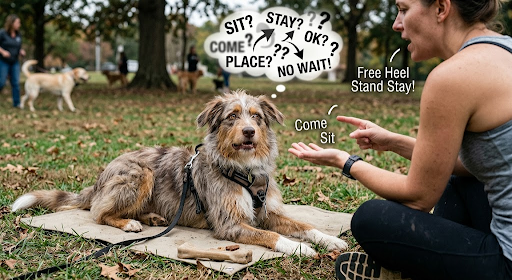
Why Clear, Predictable Language Creates Reliable Behavior
At Canine Coach Academy, we teach one core principle that transforms training results more than almost anything else: dogs thrive on consistency. They don’t understand English — they understand patterns. Every cue you use is a sound your dog learns through repetition, and when those sounds change, the meaning changes with them.
Cue consistency isn’t optional. It’s the foundation of clear communication between you and your dog.
Why Cue Words Matter More Than Most Owners Realize
Dogs learn by forming associations between a specific sound and a specific behavior. When you say “sit,” your dog isn’t responding to the meaning of the word — they’re responding to the sound pattern they’ve practiced hundreds of times.
To a dog:
- “Sit”
- “Sit down”
- “Siiiit”
are three different cues. Only one of them may be trained.
When cue words vary, dogs must guess. That guesswork leads to:
- Slower learning
- Confusion
- Broken stays
- Inconsistent obedience
- Dogs responding differently to different family members
Most dogs who “don’t listen” are actually receiving mixed signals.
The Release Cue: A Perfect Example of Trainer Variation
Few commands highlight inconsistency more than the release cue — the word that tells your dog a command is finished.
Across the training world, you’ll hear many different release words:
- Break
- Free
- Release
- Discharge
- Okay
The variation isn’t a problem. The inconsistency is.
A release cue ends the command and tells the dog they’re free to move. Without it, dogs learn to release themselves, which leads to unreliable stays, downs, and place commands.
The Problem With “Okay”
Many owners choose “okay” because it feels natural. But “okay” is used dozens of times a day in casual conversation. Dogs hear it constantly, out of context, and begin to release themselves at the wrong times.
This is why trainers often prefer words like break or free — short, clear, and rarely used accidentally.
Why Trainers Use Different Release Words
There is no universal standard for release cues. Trainers choose words based on:
- Personal training style
- The dog’s energy level
- The owner’s ability to say the word consistently
- How often the word appears in everyday conversation
Some prefer punchy words like “break.” Others choose softer cues like “free.” Some use formal cues like “release.”
The specific word doesn’t matter. Your consistency does.
How Inconsistent Release Words Confuse Dogs
Imagine teaching your dog that “break” means they’re free. Then one day you say “okay” instead.
To you, it feels interchangeable. To your dog, it’s a completely different sound — one they haven’t practiced.
This leads to:
- Hesitation
- Premature movement
- Broken stays
- Uncertainty about what you want
Dogs thrive on predictable patterns. When the pattern changes, reliability disappears.
Household Consistency Matters Just as Much
Even if you use consistent cues, your dog may still struggle if:
- Your partner uses different words
- Your kids repeat cues
- Family members add extra words (“sit sit sit sit”)
- Someone uses one cue for multiple behaviors (“down” for lie down and get off furniture)
Dogs don’t generalize cue words. They learn each sound individually. A household that uses multiple versions of the same cue creates a guessing game instead of a training system.
How to Choose and Standardize Your Cue Words
Use this simple framework to create clarity for your dog:
1. Pick one word per behavior
Sit. Down. Heel. Place. Break. No variations.
2. Choose words you don’t use casually
Avoid “okay,” “go,” “come on,” or anything used in daily conversation.
3. Create a household cue list
Post it on the fridge. Share it with your dog walker or sitter. Make sure everyone uses the same language.
4. Say cues once
Repeating cues teaches your dog to wait for multiple repetitions.
5. Keep the release cue sacred
Use it only to end commands — never casually.
Final Thoughts
Consistency is the difference between a dog who listens sometimes and a dog who listens every time. The specific words you choose matter far less than your commitment to using them the same way, every day, across every family member.
Different trainers may use different release words — and that’s perfectly fine. What matters is that you choose one and stick to it. Your dog will thank you for the clarity.

CanineCoachAcademy.com
Pawsative Training starts at the Academy
