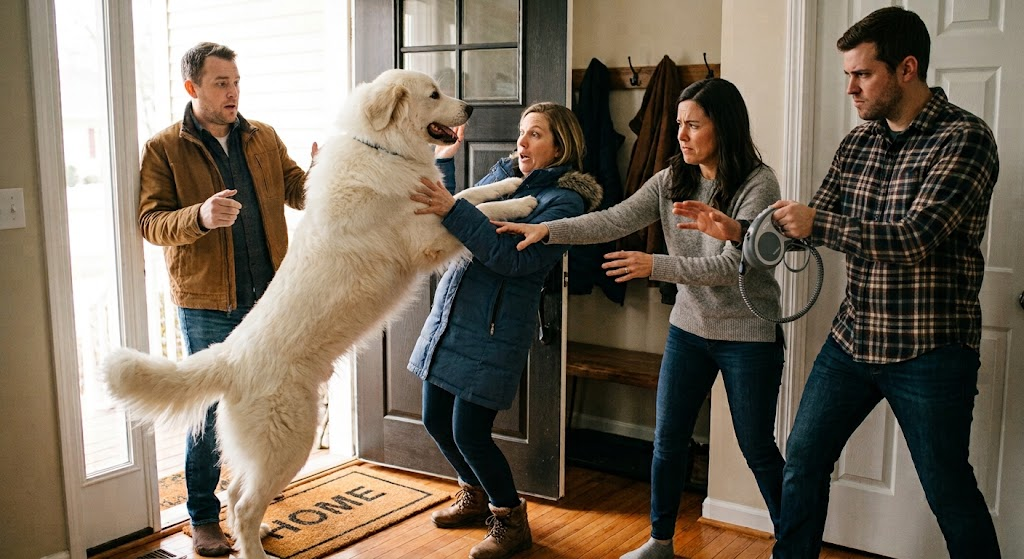
A dog jumping on guests isn’t just inconvenient — it can be unsafe, especially with large or excitable dogs. Fortunately, jumping is one of the most straightforward behaviors to fix when you apply structure, consistency, and clear communication. This guide outlines the exact steps we teach at Canine Coach Academy to create calm, predictable greetings.
Why Dogs Jump
Jumping is typically caused by two factors: excitement and accidental reinforcement. Even if you never intended to reward the behavior, many dogs interpret laughter, petting, pushing them off, or even eye contact as attention — and attention is a reward.
Dogs also naturally greet by moving toward faces and sniffing. Your job is to replace that instinct with a calmer, more appropriate greeting routine.
Step 1: Stop the Rehearsal
Before training can be effective, you must prevent the dog from practicing the unwanted behavior. Every repetition strengthens the habit.
Effective management tools include:
- Leashing the dog before guests enter
- Using baby gates or crates
- Having guests follow a structured arrival routine
Interrupting the rehearsal is the fastest way to accelerate progress.
Step 2: Use the “Step on the Leash” Technique
This technique provides immediate control and teaches the dog that jumping simply doesn’t work.
How it works:
- Clip the leash to your dog’s collar.
- Stand on the leash with enough slack for comfort — but not enough for jumping.
- Allow guests to enter calmly.
- If the dog attempts to jump, the leash prevents it. No yelling, no pushing, no physical correction.
This creates a natural, self‑correcting boundary and encourages calm behavior.
Step 3: Use a Crate or Place Command During Guest Arrivals
Crate
A crate provides a calm, controlled environment during high‑excitement moments.
How to use it:
- Place your dog in the crate before the door opens.
- Cover the crate if visual stimulation increases excitement.
- Release the dog only when calm and guests are settled.
Place Command
“Place” teaches your dog to go to a designated spot — a bed, mat, or cot — and remain there until released.
How to use it:
- Cue “Place” before opening the door.
- Reward the dog for staying on the mat.
- Allow guests to enter while the dog remains in place.
- Release only when calm behavior is present.
Both options build impulse control and prevent jumping before it starts.
Step 4: Apply the “No Touch, No Speak, No Look” Rule
Guests often reinforce jumping without realizing it. This rule eliminates accidental rewards.
Guests should:
- Not touch the dog
- Not speak to the dog
- Not make eye contact
Once the dog is calm — sitting, standing politely, or simply relaxed — guests may greet the dog only when you give permission.
Step 5: Reward Calm Behavior
Dogs repeat behaviors that work for them. Reinforce the behaviors you want.
Reward:
- Sitting
- Standing calmly
- Staying on a mat
- Looking at you instead of the guest
Ignore:
- Jumping
- Pawing
- Whining for attention
Calm behavior must become the dog’s default setting during greetings.
Step 6: Build a Predictable Greeting Routine
Dogs thrive on structure. Create a simple, repeatable ritual:
- Dog leashed or placed before the door opens
- Guests enter following No Touch, No Speak, No Look
- Dog remains calm
- You release the dog to greet
- Guest may pet only if the dog stays calm
Consistency is the key to long‑term success.
Step 7: Practice With Controlled Guests
Don’t wait for real visitors. Set up training sessions with:
- Family
- Friends
- Neighbors
- A professional trainer
The more rehearsals you control, the faster your dog learns.
When Jumping Indicates a Larger Issue
Persistent jumping can signal:
- Anxiety
- Over‑arousal
- Lack of impulse control
- Under‑exercising
If the behavior continues despite training, a structured program can help identify and resolve the underlying cause.
Final Thoughts
Stopping jumping is about structure, consistency, and calm leadership. When you combine management tools like the leash step, structured positioning through crate or place, and guest rules like No Touch, No Speak, No Look, you create a predictable environment where your dog can succeed.
CanineCoachAcademy.com
Pawsative Training starts at the Academy
